Anthropic IPO and the AI Model Race: Every Number, With Its Source
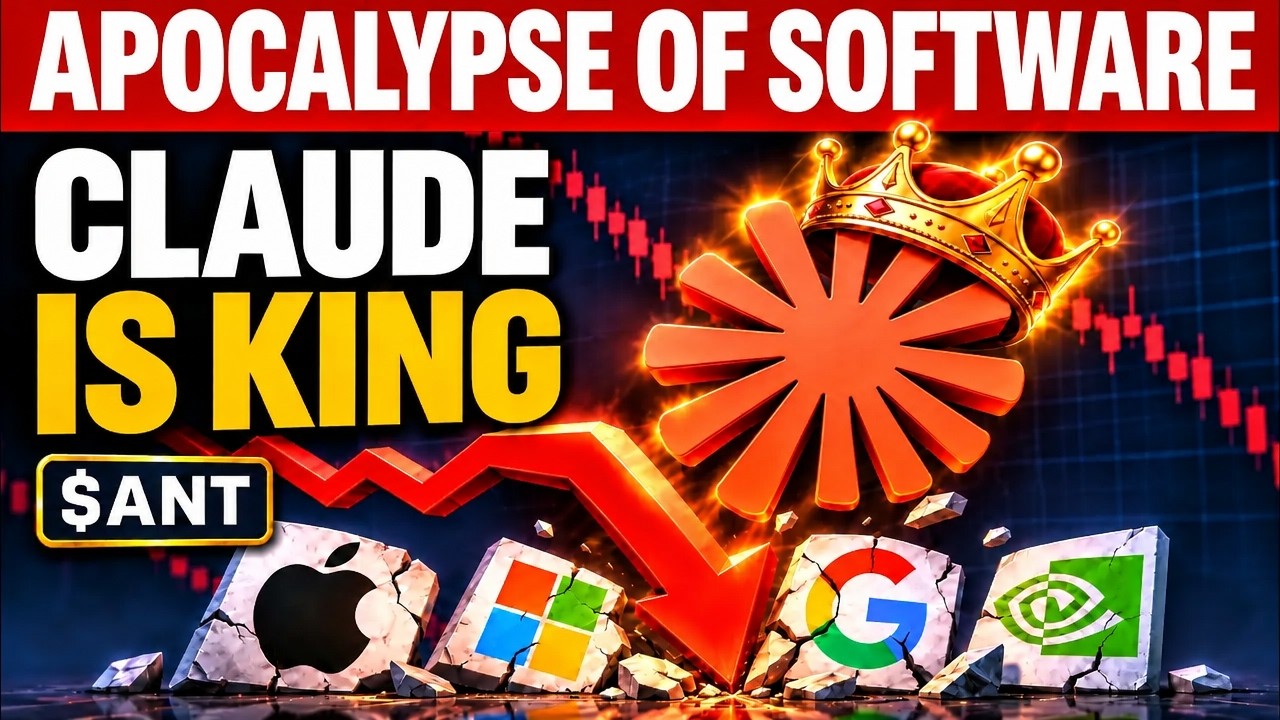
On November 19, 2026, Anthropic sold shares at $83, watched them open at $111.50 and raised $81.3 billion, the largest IPO on record. In the same ten days Google, OpenAI and Anthropic itself shipped new models with new prices, and every one of those figures was rounded, repeated and garbled within hours. I made a five-minute video about that month. This page is its reference sheet: each number from the video, next to the report it comes from, so you can check it, quote it or argue with it. Prices and forecasts here belong to their sources. None of it is financial advice.
The presenter in the video is my AI-generated twin, and the on-screen cards show the tickers, charts and benchmark panels that this page can only describe.
Key facts
- Anthropic priced its initial public offering at $83 a share on November 18, 2026, and its stock opened on the Nasdaq under the ticker ANT at $111.50 on November 19, 2026, 34% above the offer price (0:20; Reuters).
- Anthropic sold 980 million shares and raised $81.3 billion, surpassing the $75 billion SpaceX raised in its June 2026 IPO (0:20; CBS News).
- Anthropic stock closed its first day at $97.17, up 17% from the $83 IPO price, with a market capitalization of $1.27 trillion according to Forbes, or about $1.77 trillion on a fully diluted basis (counting options and other shares not yet issued) according to Reuters (0:32; Forbes; Reuters).
- Yahoo Finance (in a Trefis analysis) put Anthropic at $1.26 trillion to $1.41 trillion fully diluted at the $70 to $78 pre-IPO range, 2.4 to 2.7 times the combined $516 billion of Salesforce, ServiceNow, Adobe, Intuit and Workday (0:57; Yahoo Finance).
- On Google’s Multimodal Knowledge Agent evaluation, Artificial Analysis measured Gemini 4 Neon at 56% and Claude Fable 5.2 (max) at 57% (1:34; Artificial Analysis).
- On MindStudio’s KingBench 4 coding run, Gemini 4 Neon’s six-app run cost $20.36 at list prices against $222 for Claude Fable 5.2 (1:40; MindStudio).
- OpenAI says GPT-6.2 Astra scores 5.5 points ahead of Claude Fable 5.2 on Agents’ Last Exam at 5% of the cost, and prices Astra at $8 input and $40 output per million tokens and GPT-6.2 Sol at $2 and $10 (1:54; OpenAI).
- Anthropic launched Claude Sheets, Claude Whiteboards and Claude Meetings on November 10, 2026, with Claude Meetings in beta on Team and Enterprise plans and working with Google Meet at launch (2:29; TechCrunch).
- The video says Claude artifacts can be installed as desktop apps on Mac and Windows from November 24, 2026, in beta on every plan from Free to Enterprise (2:56).
What did Anthropic’s IPO price at, open at and raise?
Anthropic priced at $83, opened at $111.50 and raised about $81.3 billion. An IPO, or initial public offering, is the first sale of a company’s shares to the public, after which they trade on an exchange. The offer price is what the first buyers paid the company; the opening price is the first trade on the exchange. The gap between the two is the “IPO pop”.
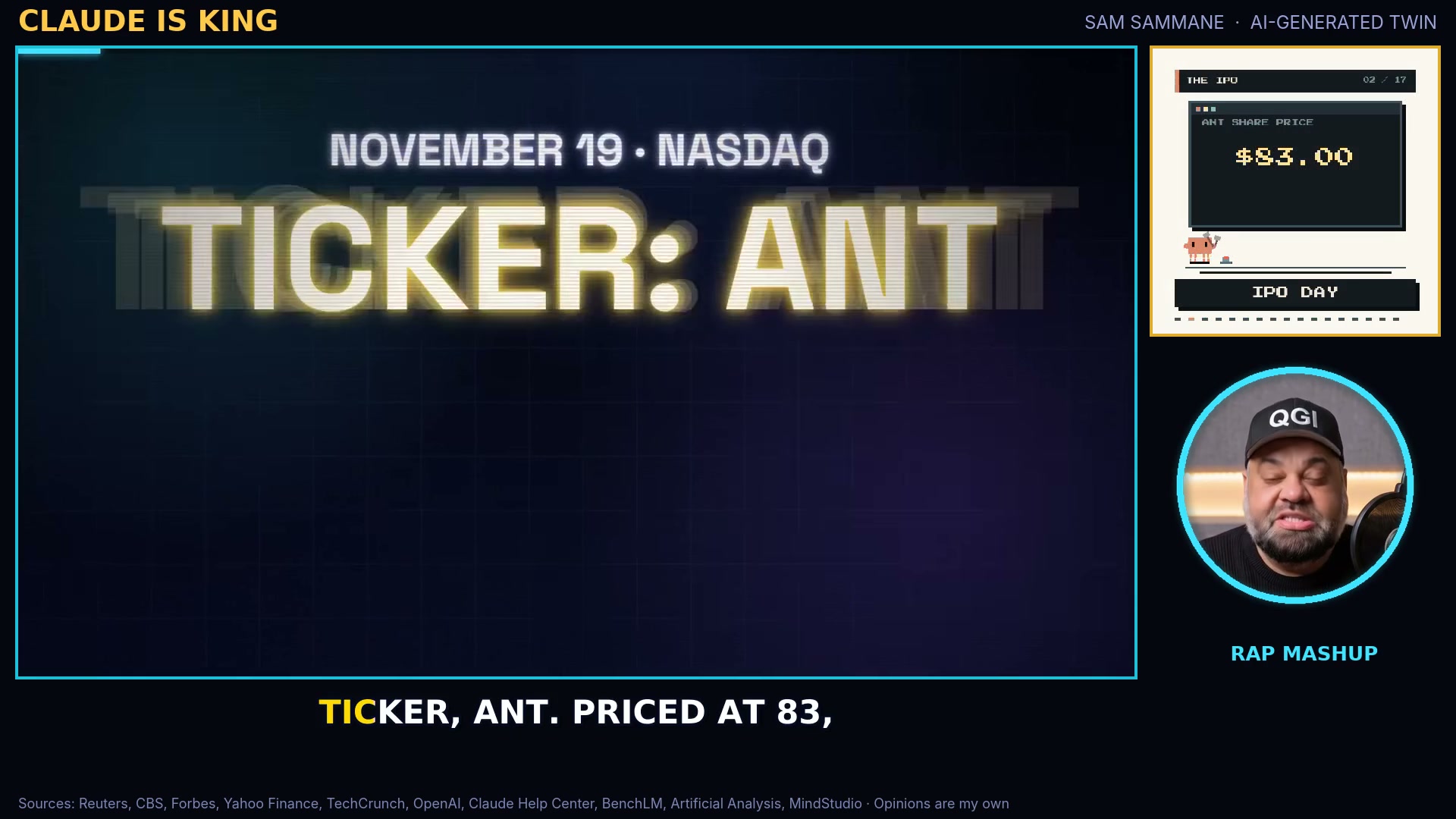 The IPO day card, at 0:22.
The video gives the headline three numbers in one breath: priced at 83, opened at $111.50, raised 81 billion, “biggest IPO in history” (0:20). Here is what the three reports the video names add to them.
Reuters reported that Anthropic sold 980 million shares at $83, above the initial range of $70 to $78 it set when it launched its road show. The proceeds could climb to as much as $93.5 billion if underwriters fully exercise their option to buy more shares (the “greenshoe”, an option that lets the banks sell extra shares when demand is high). Counting a separate $26 billion private placement with AMD, Broadcom, Google, Micron, Microsoft, Nvidia and TSMC, Reuters put the total at over $107 billion. Underwriters led by Goldman Sachs and Morgan Stanley earn a $550 million fee, according to a regulatory filing Reuters cited.
Forbes reported that Anthropic first planned, in its October 26 filing, to sell 825 million shares at $70 to $78, then raised both the size and the price. Forbes put SpaceX’s June record at $75 billion from 555.56 million shares. Shares opened “just before noon”, and by 1:30 p.m. EST more than 600 million had changed hands, Forbes wrote, citing CNBC.
CBS News reported the same $83 price, $111.50 open and $81.3 billion raise, and said the public float, the share of stock that can actually trade, is 7.4% according to Renaissance Capital, or up to 9.8% counting non-founder employee Class A shares.
| IPO day figure | Number | Source |
|---|---|---|
| Ticker | ANT, Nasdaq | Forbes |
| Initial range | $70 to $78 | Reuters, Forbes |
| Offer price | $83 | Reuters, CBS News, Forbes |
| Shares sold | 980 million (from 825 million planned) | Reuters, Forbes |
| Raised | $81.3 billion | Reuters, CBS News, Forbes |
| Private placement | $26 billion | Reuters, CBS News |
| Opening price | $111.50 (+34%) | Reuters, CBS News, Forbes |
| Intraday high | $114.99 (CBS News), $115.10 (Forbes) | as listed |
| Close, November 19 | $97.17 (+17%) | Reuters, CBS News, Forbes |
| Underwriting fee | $550 million | Reuters |
CBS News and Forbes differ by eleven cents on the day’s high. I give both rather than pick one.
What was Anthropic actually worth on day one?
Between $1.27 trillion and about $2 trillion, depending on which shares you count and at what minute. The video says “Peak valuation over two trillion, says CBS” (0:32), and CBS News did write that the $114.99 high valued the company at over $2 trillion at its peak, and that at the $83 IPO price it was worth roughly $1.5 trillion, more than Berkshire Hathaway, JPMorgan Chase, Visa or Walmart.
The difference is a definition. A fully diluted valuation counts every share that could exist, including stock options and restricted stock units promised to employees but not yet vested. Reuters explained that the roughly $2 trillion figure is fully diluted, and that on outstanding shares the company reached as much as $1.5 trillion on November 19, on par with Tesla. Forbes, using shares outstanding, put the market capitalization at $1.27 trillion at the $97.17 close.
So when someone tells you “Anthropic is a $2 trillion company”, the honest version is: it touched about $2 trillion fully diluted, for a short while, on its first morning, and closed the day nearer $1.3 trillion on the shares that trade.
What did the revenue and the costs look like?
Revenue grew more than elevenfold in a year; so did the bill. The video’s caption at this point is garbled (“Revenue up,00% year-over-year per Reuters”), so I take the figure from Reuters itself rather than guess at it.
Reuters reported, from the company’s IPO prospectus, that revenue surged more than 1,100% in the three months ended September 30, 2026, from a year earlier, and that third-quarter revenue rose 47% from the previous quarter as the net loss narrowed. Reuters also counted nearly $900 billion in computing commitments with partners including Amazon and Google.
Forbes reported revenue of $16.3 billion in the first half of 2026, up from $1.2 billion a year earlier, with a first-half net loss of $80.7 billion against $13 billion a year earlier. The top five customers made up around 25% of revenue for the nine months to September 30, though no single customer passed 10%. Forbes added that Anthropic has spent $19 billion on AI infrastructure since its founding, that its largest contract is $161 billion with Broadcom, and that obligations could total around $1 trillion through 2045, according to the prospectus.
CBS News noted that the company has not turned a profit and had $6.2 billion in debt as of September 30.
Was the stock a buy on day one?
The video’s answer is a joke with a warning inside it: “Don’t yolo your rent money.” (0:44). It cites “one strategist” who said the stock is not a buy at any price, and adds that day-one buyers of hot tech IPOs usually lag the market.
That strategist is Talley Leger, chief market strategist at The Wealth Consulting Group. Reuters quoted him: Anthropic “isn’t a prudent ‘buy-at-any-price’ opportunity for retail wealth clients,” and “History shows that retail investors buying hot tech IPOs on day one historically underperform broad market indexes over a 3-year horizon.”
CBS News cited a Truist study: of 32 of the biggest IPOs ever, more than half fell at least 50% at some point in their first year. On the other side, CBS quoted Dan Ives calling the listing an “A-plus success.”
What happened next came after the video was published. Forbes reported on November 20 that the stock fell more than 11% on its second morning, trading at $86.10 after the first hour and touching $83.93 before the bell, close to the $83 offer price. I record that as a fact, not a forecast. Nothing here tells you what the stock will do.
How does Anthropic compare with Salesforce, ServiceNow, Adobe, Intuit and Workday?
At its pre-IPO price range, Anthropic was worth 2.4 to 2.7 times those five companies combined. The video gives the multiple and the source on screen (0:57), then the line that sums up the chapter: “So the software that eats software just ate the software companies.” (1:08).
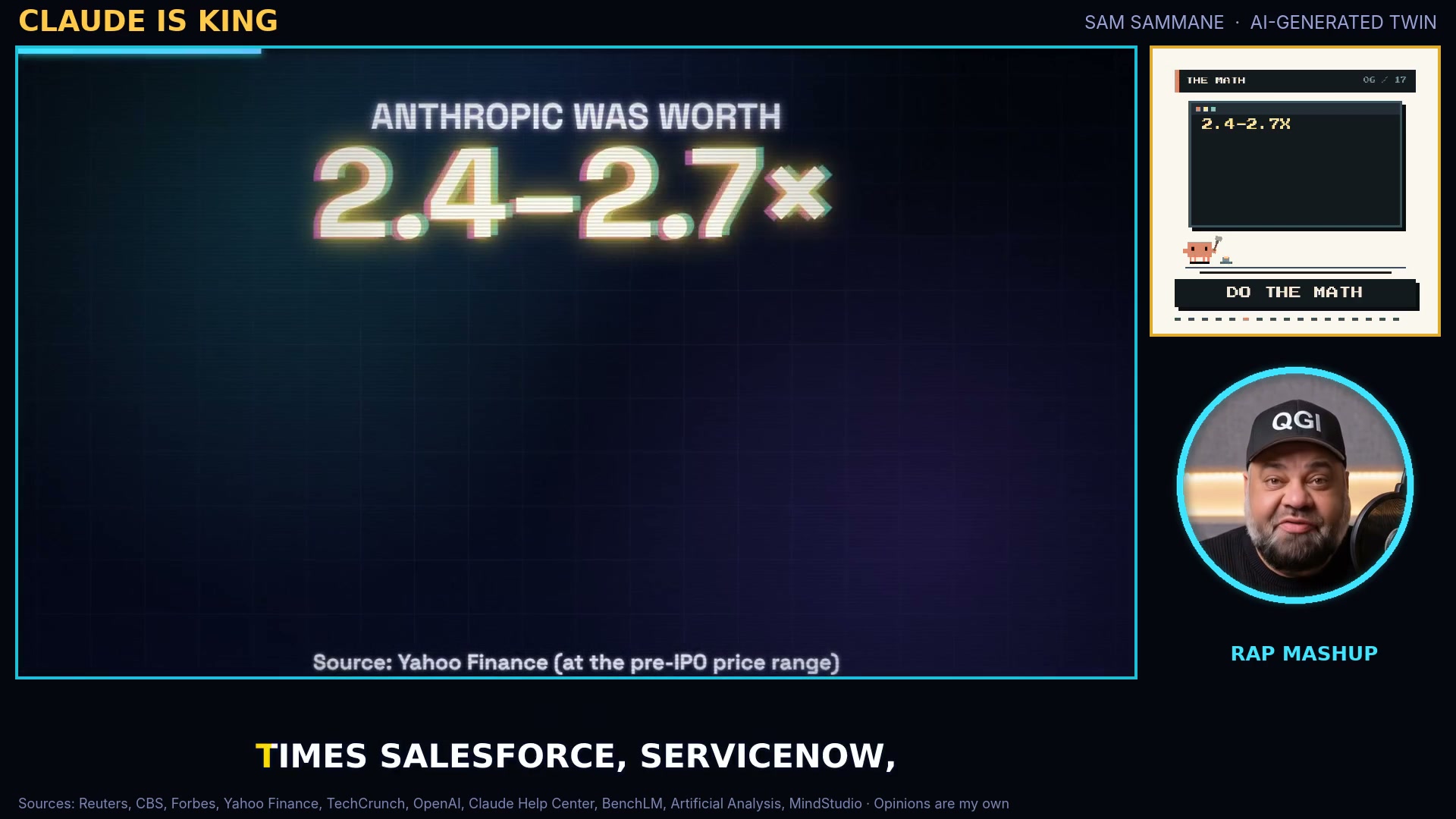 The valuation multiple, at 1:05.
The figure comes from a Trefis analysis published on Yahoo Finance on November 12, 2026: at $70 to $78, Anthropic was worth $1.26 trillion to $1.41 trillion fully diluted, against a combined $516 billion for Salesforce, ServiceNow, Adobe, Intuit and Workday. Note that this used the range, not the final $83 price.
The same piece compares price-to-sales, a company’s market value divided by its last four quarters of sales. Salesforce traded at 4.1 times sales, ServiceNow 6.9, Adobe 3.6, Intuit 4.3 and Workday 4.5; the five together at 4.4. Anthropic, at the range, came to 36 to 40 times its $35.3 billion of sales in the four quarters to September, with latest-quarter sales up 1,127%. Trefis also reported that 79% of Anthropic’s revenue this year came from usage and 21% from subscriptions, and that ServiceNow fell 3.1% on the Tuesday Anthropic launched its own sheets and data tools. The reel cut from this video walks through the same multiple in thirty seconds; here the numbers simply sit together with their source.
Which model leads the benchmarks?
Claude Fable 5.2, on BenchLM’s leaderboard, by a margin BenchLM itself calls a lead rather than a settled win. A benchmark is a fixed set of tasks every model is scored on, so different models can be compared on the same test.
The video says “Bench LM 92.8 versus Gemini 4 Carbon’s 85” (1:20). When I opened BenchLM’s comparison page on November 22, 2026 (it was last updated November 21), it listed Claude Fable 5.2 at 92.8 in the agentic category and 93.3 overall, ranked first, and Gemini 4 Carbon at 88.6 agentic and 88.3 overall, ranked fourth. I could not find the 85 on the current page, so I report what BenchLM shows now. BenchLM’s own note: “Claude Fable 5.2 has the higher public score estimate, 93.3 versus 88.3, but the 90% score intervals overlap. Treat that as a lead, not a settled winner.”
BenchLM also lists the release dates, November 9, 2026 for Claude Fable 5.2 and October 28, 2026 for Gemini 4 Carbon, and the list prices: $8 input and $40 output per million tokens for Fable 5.2, $2 and $10 for Carbon.
How close is Gemini 4 Neon to Claude Fable 5.2?
One point, on the test the video quotes. Artificial Analysis says Neon hits 56% on Google’s agent test against 57% for Fable, and the video’s reaction is “One point, bro. One.” (1:34).
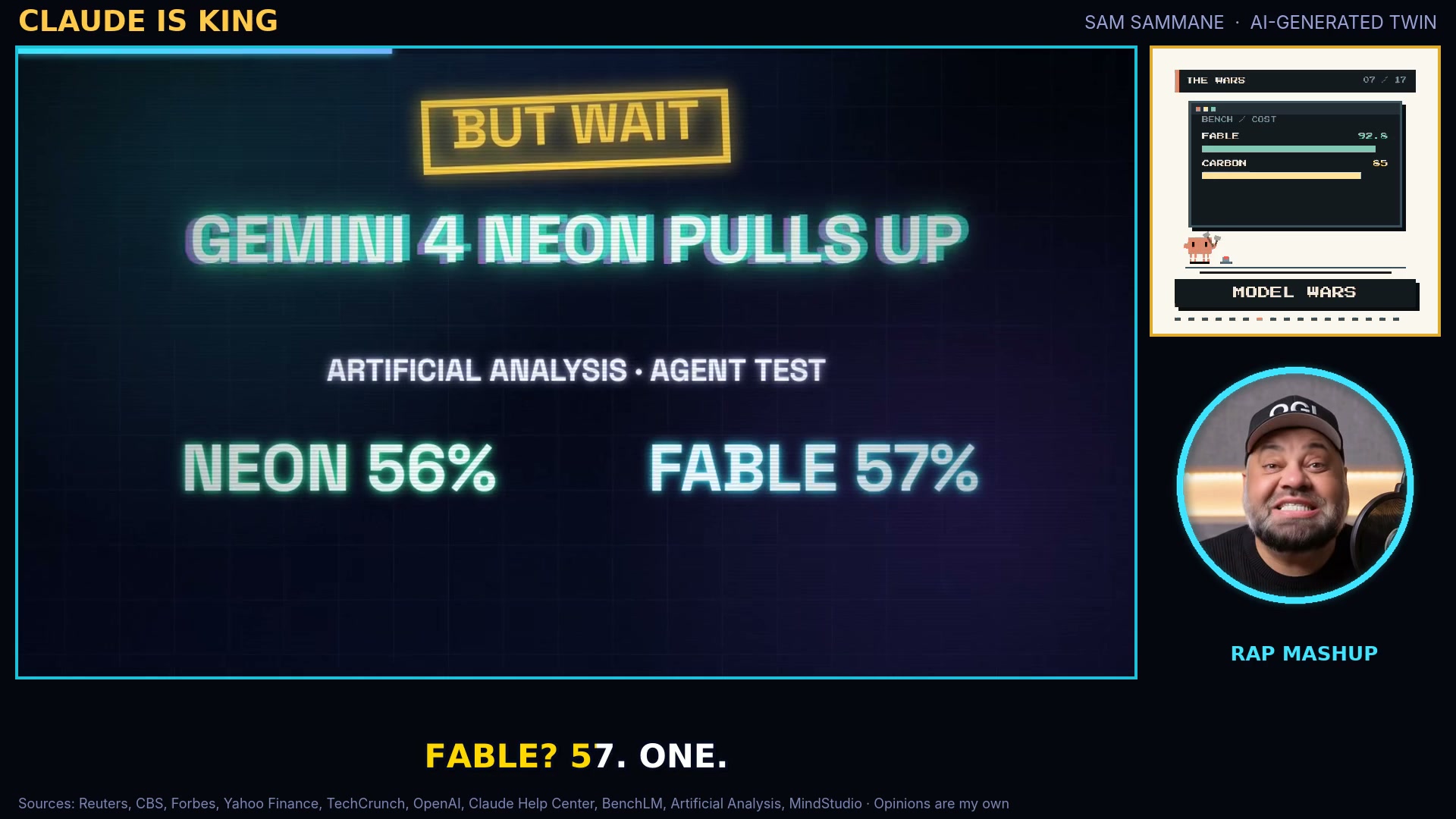 Gemini 4 Neon against Fable 5.2, at 1:40.
Artificial Analysis wrote on November 18, 2026 that on Google’s Multimodal Knowledge Agent evaluation (MKA), Neon reaches 56%, up 2 points from Carbon and on par with the leader, Claude Fable 5.2 (max), at 57%. The same write-up reports:
- Neon (xhigh) scores 61 on the Artificial Analysis Intelligence Index, 1 point ahead of Gemini 4 Carbon and third overall, behind GPT-6.2 Astra (max) and Claude Fable 5.2 (max).
- On the Coding Agent Index, Neon in Google’s Antigravity CLI scores 59, in line with Claude Code running Fable 5.2 (xhigh, 58) and Claude Opus 5.5 (max, 58).
- On that coding agent test, the average cost per task (what one benchmark task costs to run) was $6.86 for Neon in Antigravity, $12.61 for Claude Opus 5.5 (max) and $15.47 for Claude Fable 5.2 (xhigh).
- Neon is priced at $3 input and $15 output per million tokens, 25% below Carbon’s standard $4 and $20, and 50% above Carbon’s discounted $2 and $10, a discount that ends on November 30.
What did the coding run cost?
About eleven times more for Fable. The video: “on a Mind Studio coding run, Neon cost 20 bucks”, followed by the line of the chapter, “King of the Hill and King of the Bill.” (1:44). The caption renders Fable’s figure as “Fable 222”; MindStudio’s report confirms it is $222.
MindStudio reported on November 19, 2026 that on KingBench 4, a benchmark of six full software projects built from one prompt each, Gemini 4 Neon’s run cost $20.36 at list pricing against $222 for Claude Fable 5.2 and $234 for Gemini 4 Carbon on intro pricing. Fable 5.2 stayed the quality leader at 42 out of 60; Neon placed second of 18 models at 37.9 (63.2%), ahead of Claude Opus 5.5 (34.7) and GPT-6.2 Astra (33.9 and 33.6 across two runs). Fable used around 212 million tokens to Neon’s 27.1 million, and rewrote whole files 31 times to Neon’s three. MindStudio’s summary: Neon delivered roughly 90% of Fable’s score for less than a tenth of the API cost.
What did OpenAI claim for GPT-6.2 Astra and Sol?
That Astra beats Claude Fable 5.2 on a professional-work benchmark at a twentieth of the cost. The video introduces the two models (1:54), Astra as “the heavy hitter for hard pro work” and Sol as “the cheap daily driver”, then reminds you who is talking: “But those are OpenAI’s own numbers.” (2:22).
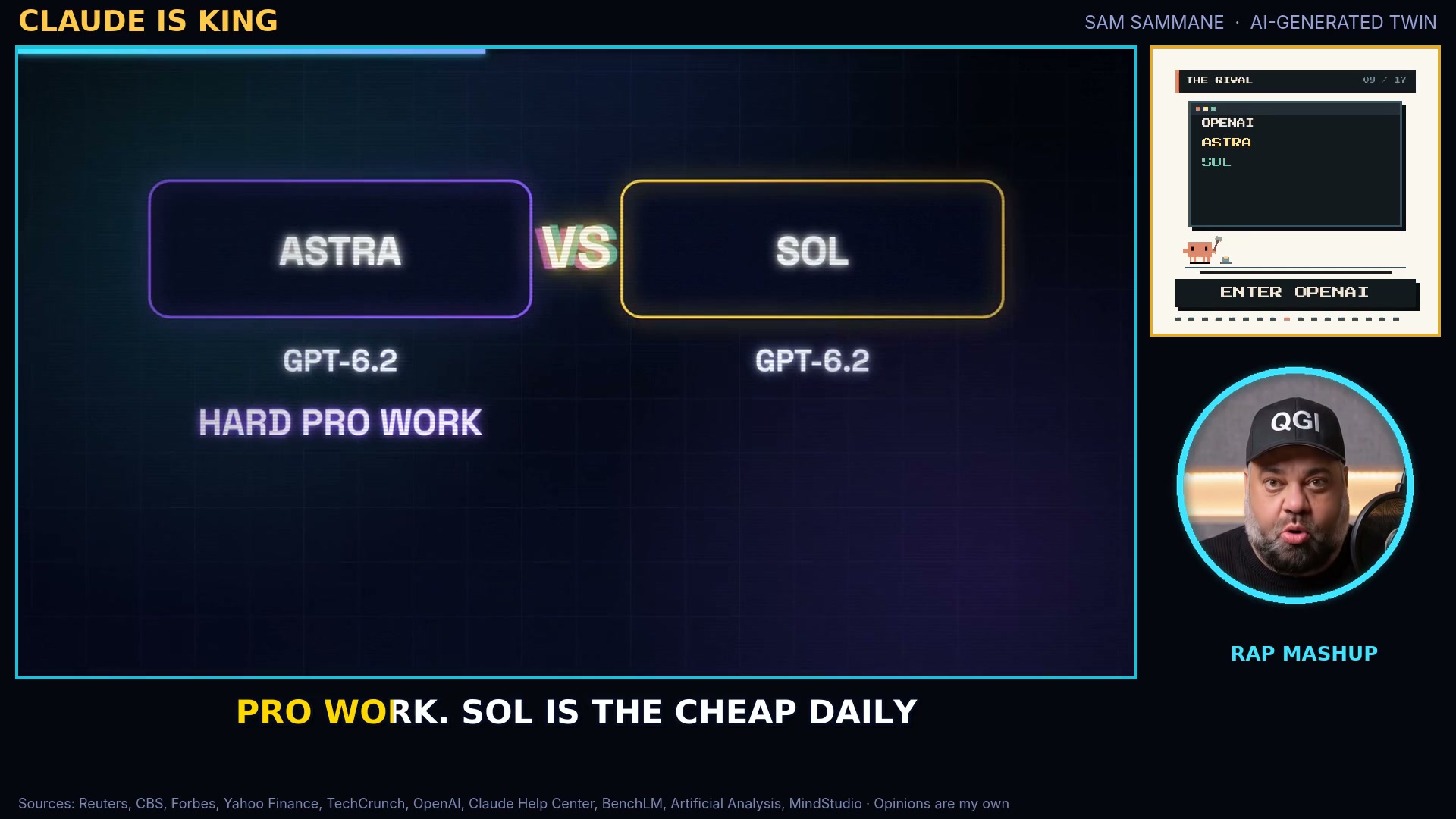 GPT-6.2 Astra and Sol, at 2:05.
The caption calls the benchmark “agents last exam”. OpenAI’s own name for it is Agents’ Last Exam (version 1.1 in its chart), which “tests multistep professional work”. OpenAI’s announcement says GPT-6.2 Astra scores 5.2 points higher than GPT-6 Astra at less than a third of the cost, “and 5.5 points ahead of Claude Fable 5.2 at just 5% of the cost.” Artificial Analysis, independent of OpenAI, dated its own write-up of the release November 17, 2026 and placed Astra second on its Intelligence Index.
API token pricing is how developers pay for a model: a set price per million tokens (small chunks of text) sent in, and a higher price per million tokens the model writes back. Cached input is text the model has already seen in the same session, billed at a discount. OpenAI lists:
| Model | Input | Cached input | Output | Source |
|---|---|---|---|---|
| GPT-6.2 Astra | $8 | $0.40 | $40 | OpenAI |
| GPT-6.2 Sol | $2 | $0.10 | $10 | OpenAI |
| Claude Fable 5.2 | $8 | — | $40 | BenchLM |
| Gemini 4 Neon | $3 | $0.15 | $15 | Artificial Analysis |
| Gemini 4 Carbon | $2 (intro, to November 30); $4 standard | — | $10 (intro); $20 standard | Artificial Analysis |
All prices are per million tokens. Read the table with the cost-per-task figures above in mind: Fable 5.2 and Astra carry the same list price, yet OpenAI’s claim is about what a whole task costs, which depends on how many tokens each model spends. OpenAI says both models are available in ChatGPT Work and Codex for Plus, Pro, Enterprise and Edu users, and in the API as gpt-6.2-astra and gpt-6.2-sol.
When did each launch?
Ten launches and market dates in five weeks, from the sources above:
| Date (2026) | Event | Source |
|---|---|---|
| October 26 | Anthropic files its IPO prospectus publicly | Forbes |
| October 28 | Gemini 4 Carbon released | BenchLM |
| November 9 | Claude Fable 5.2 released | BenchLM |
| November 10 | Claude Sheets, Whiteboards and Meetings launch | TechCrunch, Anthropic |
| November 12 | Yahoo Finance publishes the five-company comparison | Yahoo Finance |
| November 17 | GPT-6.2 Astra and Sol released | Artificial Analysis |
| November 18 | Gemini 4 Neon released; Anthropic prices its IPO at $83 | Artificial Analysis, Forbes |
| November 19 | ANT opens at $111.50, closes at $97.17 | Reuters, CBS News, Forbes |
| November 24 | Artifacts as desktop apps, in beta | the video |
| November 30 | Gemini 4 Carbon’s discounted price ends | Artificial Analysis |
What did Anthropic launch on November 10?
Three office tools inside Claude. The video: “November 10th, anthropic goes corporate. Claude Sheets, Claude whiteboards, Claude meetings.” (2:29).
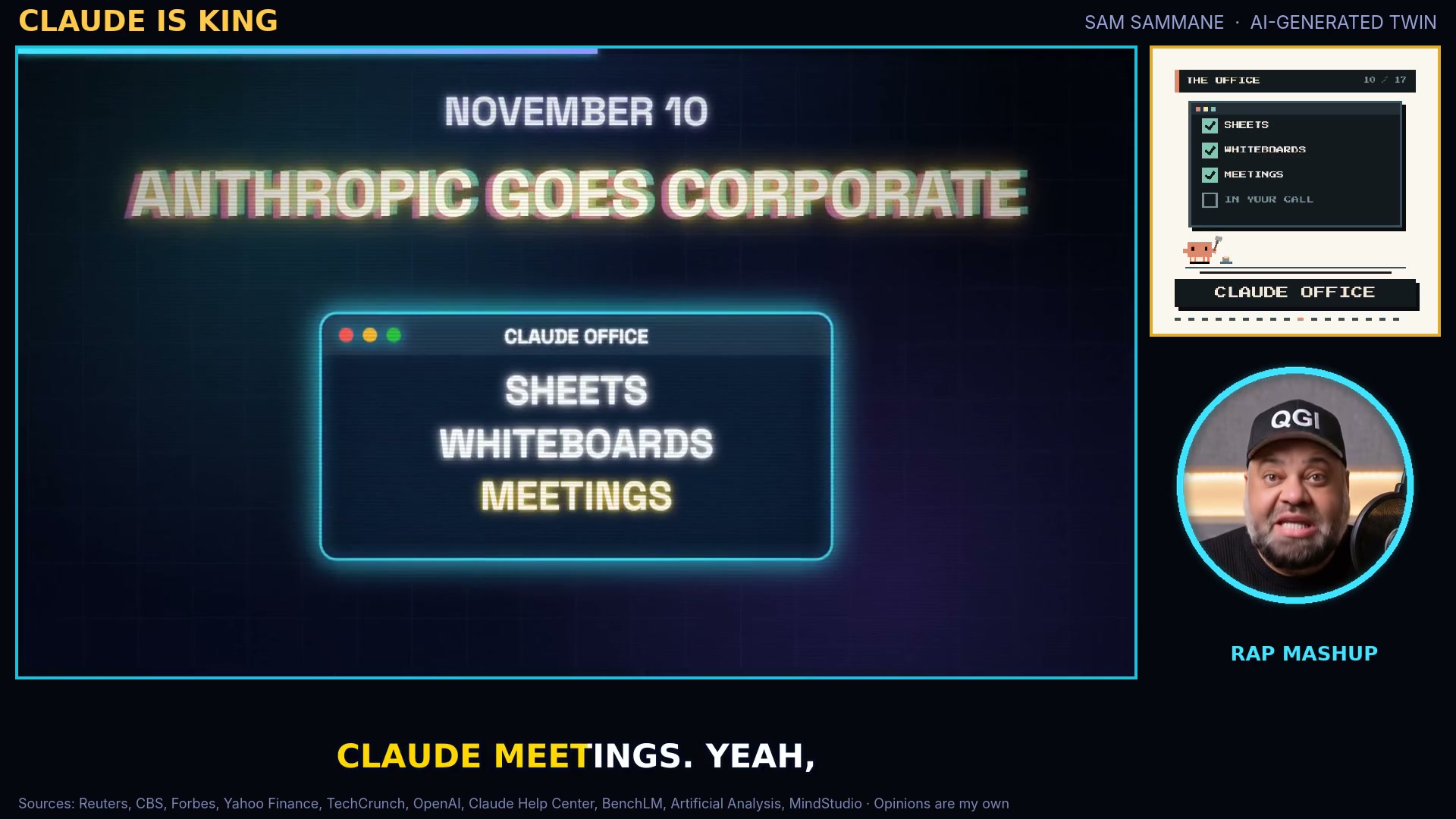 The November 10 launch, at 2:35.
TechCrunch reported that Claude Meetings adds Claude to a video call as a visible participant, drafts the plan being discussed and maps a timeline on a whiteboard while people talk, and leaves automatically if an external guest joins. It launched in beta on Team and Enterprise plans and works with Google Meet at launch. Claude Sheets and Claude Whiteboards are in beta on paid plans, on web, desktop and mobile. Anthropic’s own announcement says: “For now, sheets have simple spreadsheet functionality, but we are working on adding more.”
MLQ.ai reported that Microsoft shares fell about 3% in a sudden midday move that day, citing CNBC, and that an Anthropic product leader told Bloomberg Sheets is relatively basic and not built for sophisticated financial modeling. The video’s version: “So Excel isn’t dead. It’s just nervous.” (2:48). What these tools change for how companies buy software is the subject of the LinkedIn article from this video.
What changes on November 24?
Claude artifacts become apps you install. An artifact, in the Claude Help Center’s words, is “anything Claude makes for you that you’d put in front of someone: a design, a deck, a document, a dashboard, or a small interactive tool.”
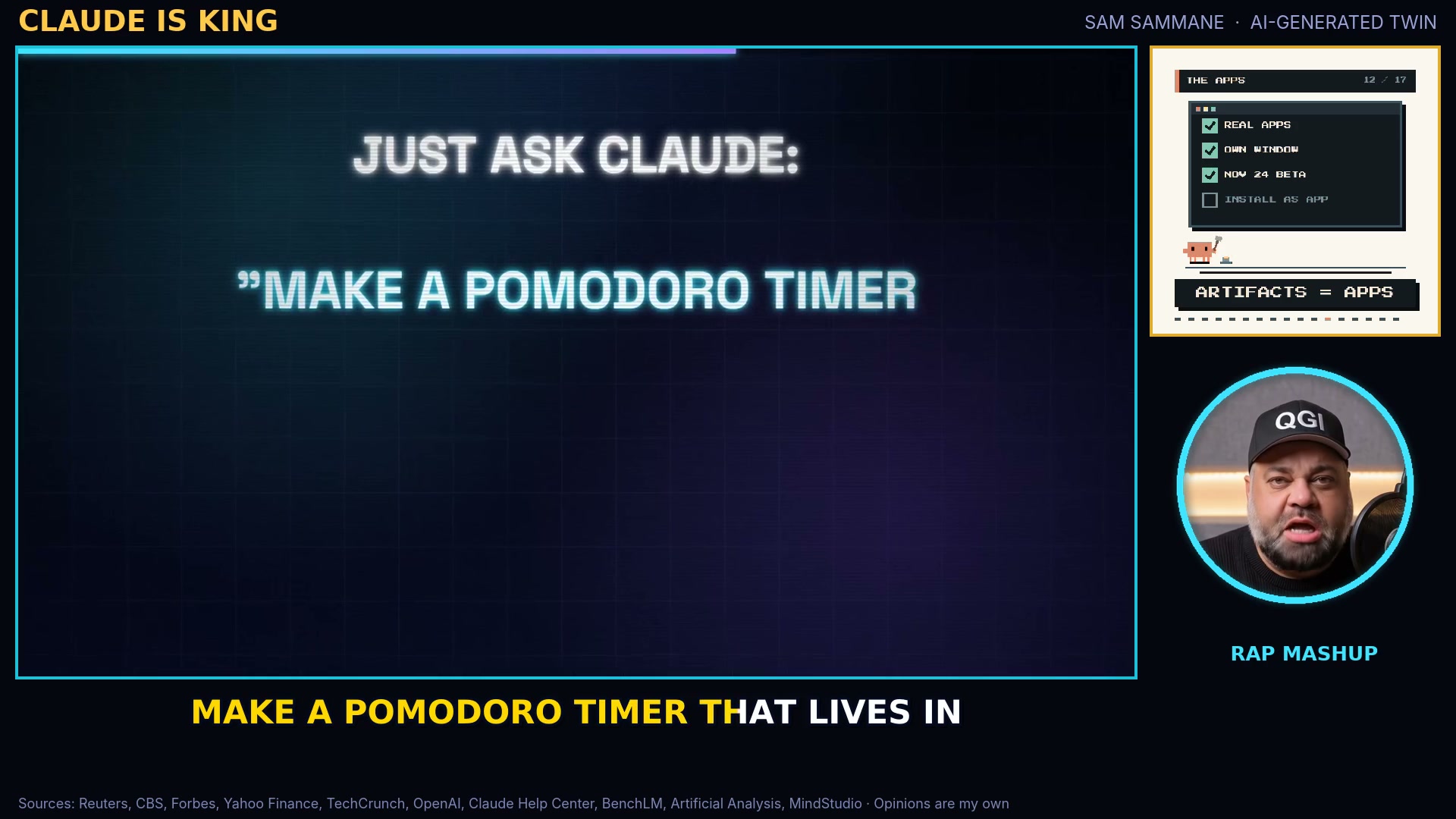 The example prompt, at 3:12.
The video gives the facts in its own words (2:56): from November 24, in beta, on every plan from Free to Enterprise, an artifact can get its own window and its own icon on a Mac or Windows computer. “Apps ask before they do anything.” (3:18); Full Access can run programs and change your files; “Anthropic doesn’t review these apps. Only allow it if you trust who wrote it.” There is no Linux or mobile version yet. I could not find the Help Center page for this feature, so these details rest on the video alone. The step-by-step install is the Instagram post from this video.
What does Claude Fable block?
Offensive cybersecurity, much of dual-use biology, a narrow set of frontier AI development tasks, and attempts to extract its reasoning. The video lists the same four (3:34).
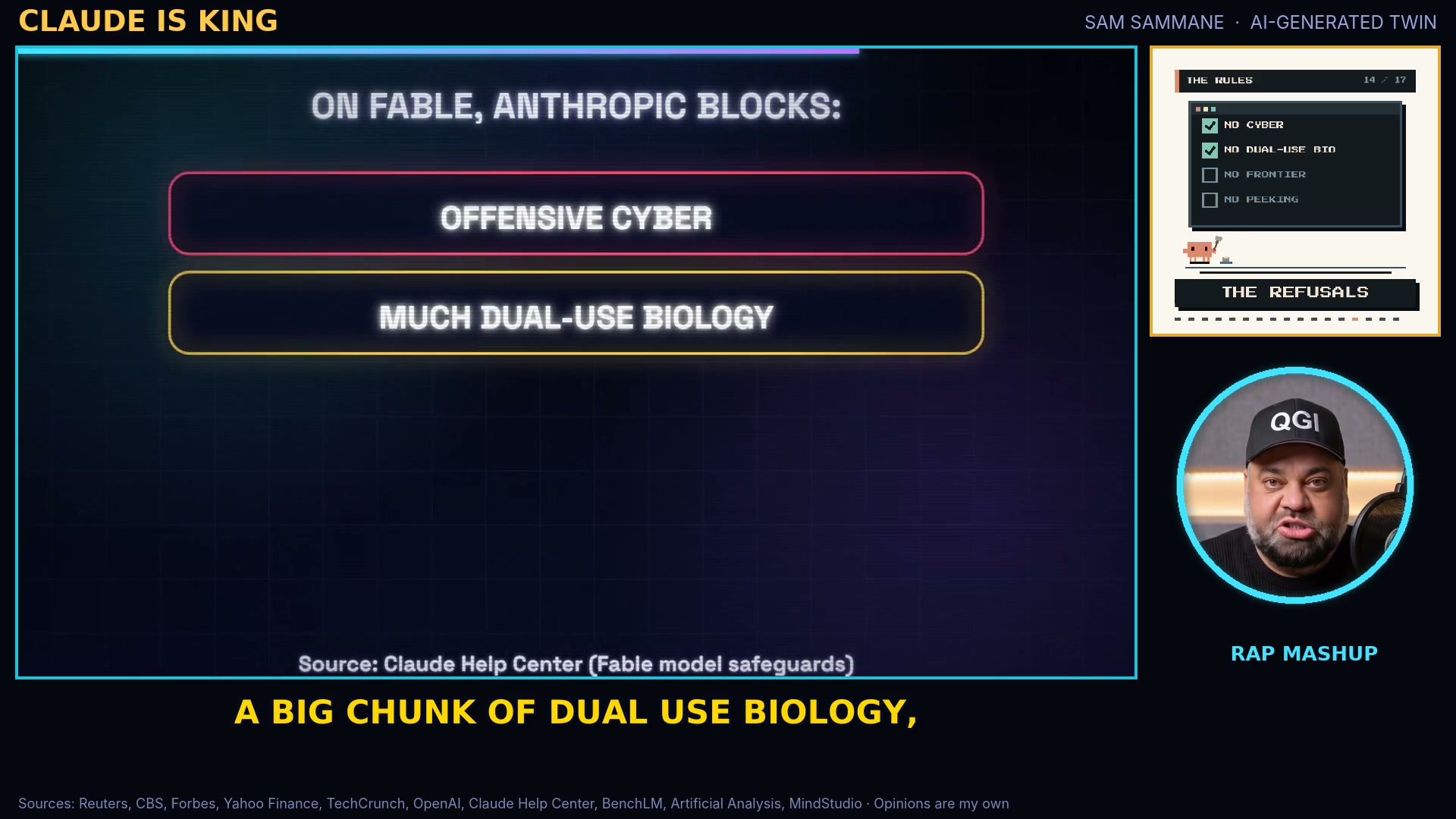 The safeguards card, at 3:45.
The Claude Help Center says Fable 5.2 runs automated safety checks, called classifiers, on every request. A fallback is what happens when one fires: the request is answered by a less capable model instead, currently Opus 5 for biology and frontier LLM development requests and Opus 4.8 for offensive cybersecurity. Requests that try to extract the model’s reasoning “are blocked outright. They don’t fall back to another model.” The page names the blocked areas: offensive cybersecurity techniques such as building exploits, malware or attack tooling; “a large fraction of queries we consider dual-use in biology, such as virology, toxicology, drug design, and molecular design”; and frontier LLM development tasks such as distributed training infrastructure and ML accelerator design. The reason it gives: without strong safeguards, these capabilities “could be misused by users to create large-scale cyberattacks or bioweapons that could result in catastrophic damage.” The video closes the chapter with a question, “So, is it a seat belt or a muzzle? Maybe both.” (4:04); the Facebook article from this video takes that debate on in full.
What happens to software engineers?
The video’s answer is that the work moves rather than disappears: “My take, the job shifts. Less typing code, more designing, reviewing, and securing what AI builds.” (4:16).
 The closing question, at 4:18.
The benchmark reports above point the same way. MindStudio’s run is a list of review problems: Neon’s Docker alternative let a hostile container write to the host disk through seven separate symlink escapes, and its Fitbit app was coded against an API Google had already shut down. Those are the faults a person who knows “what to ask for and what to say no to”, in the video’s phrase, catches before shipping.
Key takeaways
- The IPO in four numbers: $83 offer, $111.50 open, $97.17 close, $81.3 billion raised (Reuters, CBS News, Forbes).
- “$2 trillion” is fully diluted and was brief; Forbes put the first-day close at $1.27 trillion on shares outstanding.
- On benchmarks, Claude Fable 5.2 leads narrowly; Gemini 4 Neon is a point behind on Google’s MKA test and cost $20.36 to Fable’s $222 on MindStudio’s coding run.
- OpenAI’s Agents’ Last Exam claim against Fable 5.2 is OpenAI’s own number.
- Every price and forecast here belongs to its source and is not financial advice.
Video details
- Title: Claude vs The World: Why this IPO changes everything
- Channel: TheoSym by Sam Sammane
- Published: 20 November 2026
- Length: 4:59
- Chapters:
- 0:00 Claude is king? Says who?
- 0:20 The IPO: $83 price, $111.50 open, $81B raised, the biggest IPO ever
- 0:57 The math: worth 2.4–2.7x Salesforce + ServiceNow + Adobe + Intuit + Workday combined
- 1:20 Model wars: Fable 5.2 vs Gemini 4 Carbon & Neon (“king of the hill… and king of the bill”)
- 1:54 Enter OpenAI: GPT-6.2 Astra & Sol
- 2:29 Claude goes corporate: Sheets, Whiteboards, Meetings
- 2:56 Artifacts become real apps (Nov 24 beta)
- 3:34 Real talk: refusals, safeguards, seatbelt or muzzle?
- 4:16 The end of software engineering as we know it
- 4:30 Your verdict
FAQ
Is Claude king? For now, the video says: “So yeah, Claude is king for now.” (4:26). It leads BenchLM’s board, but Gemini 4 Neon is one point behind on Google’s agent test, and OpenAI claims Astra ahead on Agents’ Last Exam.
Should I buy Anthropic stock? The video does not tell you to, and neither do I. It says “Don’t yolo your rent money” and cites a strategist, Talley Leger, who told Reuters the stock “isn’t a prudent ‘buy-at-any-price’ opportunity for retail wealth clients.” Not financial advice.
Did Anthropic really raise more than SpaceX? Yes: $81.3 billion against SpaceX’s $75 billion in June 2026, according to CBS News and Forbes (0:32). Reuters notes that its record table does not count the underwriters’ option to sell extra shares.
Does GPT-6.2 Astra beat Claude Fable 5.2? OpenAI says so on Agents’ Last Exam, by 5.5 points at 5% of the cost. The video stresses that “those are OpenAI’s own numbers.” (2:22).
Is Excel dead? No: “So Excel isn’t dead. It’s just nervous.” Anthropic itself calls Sheets “simple spreadsheet functionality” for now (2:48).
What happens to software engineers? The job shifts toward designing, reviewing and securing what AI builds, the video says (4:16).
Watch it, then tell me your verdict
The cards, the charts and the tone are in the video:
The video ends by asking whether Claude is king or just the main character this week; answer in the comments there. If you want to follow the channel’s work beyond YouTube, you can join here.
About the author
I’m Dr. Sam Sammane, Founder and Chief Executive Officer of Quantum General Intelligence Inc. (QGI), which builds AI that shows its work, and I hold a PhD in formal verification. My credentials are at qgi.dev. Opinions in this article and the video are my own.