Jensen Huang's Return, Nov 23 2026: Every Number and Its Source
On Monday, November 23, 2026, Nvidia’s board brought Jensen Huang back as chief executive, Nvidia stock ran toward what the WSJ called its biggest one-day jump in more than two decades, and the Nasdaq rebounded from its worst week since 2020. My channel put out a fast, sarcastic recap of the day, and some of its numbers do not match the outlets it names. This article is the reference record: every figure from that Monday, with the outlet that reported it, the link, and the time of day it was true.
The video is 2 minutes and 41 seconds of the mood on the trading floor; this page is the slow version, with the receipts.
Key facts
- Nvidia’s board reinstated Jensen Huang as CEO on November 23, 2026, “just 11 days after” he was ousted, according to The Wall Street Journal’s live coverage (0:22).
- Nvidia’s board said it “received input from senior levels of the United States government”, as reported by CNBC (0:31).
- Nvidia shares “soared as much as 36%” and were “on pace to add a trillion dollars” to Nvidia’s market value, per the WSJ live page stamped 11:51am ET (0:40).
- The WSJ said that, if the gains held, it would be Nvidia’s “biggest one-day percentage move in over two decades”, in a premarket card headlined “Biggest Jump in 23 Years” (0:40).
- At 10:50 a.m. ET on November 23, 2026, the WSJ ticker showed the Nasdaq Composite up 6.99%, the S&P 500 up 5.10% and the Dow Jones Industrial Average up 3.16% at 49,669.99, on the WSJ Anthropic card (0:52).
- Anthropic (Nasdaq: ANT) was reported down roughly 3% by CoinPaper, while the WSJ, CNBC and The Economic Times reported it flat or largely unchanged (1:15).
- Anthropic’s IPO came with about $26 billion of shares sold in a private placement to chipmakers and other tech firms, per CoinPaper and Reuters (1:28).
- CrowdStrike agreed to buy Zscaler in “a $43.9 billion all-stock deal”, which Reuters called “the biggest cybersecurity acquisition on record” (1:48).
- On the CrowdStrike-Zscaler news, Zscaler shares jumped more than 20% in premarket trading and CrowdStrike shares fell nearly 7%, per Reuters (1:55).
- The “buy-at-any-price” warning on Anthropic came from Talley Leger of The Wealth Consulting Group, quoted by Reuters on November 19, 2026, the IPO day (2:03).
The video at a glance
- Title: MARKET RESURRECTION: Jensen Huang Is Back, Nasdaq +7% (2026, Nov 23)
- Channel: TheoSym by Sam Sammane. The presenter is an AI-generated twin of me, as the description says.
- Published: November 23, 2026, at 11:30 a.m. ET (16:30 UTC)
- Length: 2:41
- Sources named in the description: WSJ live coverage, Reuters, CNBC, The Economic Times, CoinPaper. The description adds: “Index figures are WSJ’s mid-morning snapshot; intraday numbers changed through the day.”
- Chapters:
- 0:00 Plot twist: Nvidia’s board brings back Jensen Huang 11 days after he was ousted
- 0:18 The drama, and Nvidia up as much as 36% (on pace for +$1 trillion)
- 0:46 Scoreboard: Nasdaq, S&P 500, Dow and VIX (WSJ, mid-morning)
- 1:13 And the king? Anthropic reportedly down ~3% while the rest of AI rips
- 1:42 CrowdStrike buys Zscaler: $44B all-stock, the biggest cyber deal on record
- 2:03 Don’t YOLO your rent
- 2:15 Recap: healthy market or reality show with tickers?
Where do the video’s figures differ from its sources?
Several of them do, and where they do, the sources win. The video was cut fast on a live day. The outlets it names published figures with timestamps, and those are the figures to cite. The index numbers in particular were live tickers that moved all day, so any single number is only true at the minute it was read.
| Claim | Video says | Source says | Source |
|---|---|---|---|
| Why Huang left | Extramarital affairs, one with a suspected Chinese spy (0:18); the video’s count is lower than CNBC’s | Reports of “several extramarital affairs”, one allegedly with an alleged Chinese spy | CNBC |
| Size of Nvidia’s move | Up as much as 36%, “most in a decade” per the Journal (0:35) | “As much as 36%”; “biggest one-day percentage move in over two decades” | WSJ main page, WSJ card |
| Nasdaq | +7.6% (0:52) | +6.99% at 10:50 a.m. ET; +6.45% at about 11:51 a.m. ET; subhead “Nasdaq rebounds 7%“ | WSJ card, WSJ main page |
| S&P 500 | +5.5% | +5.10% at 10:50 a.m. ET; +4.73% at about 11:51 a.m. ET | WSJ, same pages |
| Dow | +3.4%, near 50,000 | +3.16% at 49,669.99 (10:50 a.m. ET); +3.08% at 49,629.38 (11:51 a.m. ET) | WSJ, same pages |
| VIX | -24% | -26.39% at 10:50 a.m. ET; -21.68% at 11:51 a.m. ET | WSJ, same pages |
| Bitcoin | Back above $63K (1:04) | $62,960.14 at 10:50 a.m. ET; $62,093.66 at 11:51 a.m. ET; about $61,500 per CoinPaper | WSJ; CoinPaper |
| Oil | Down 3%, about $80 | $80.47, -3.52% (10:50 a.m. ET); $80.20, -3.85% (11:51 a.m. ET) | WSJ, same pages |
| Anthropic (ANT) | Reportedly down about 3% (1:15) | Down roughly 3% (CoinPaper); near flat (WSJ, 10:49 a.m. ET); flat (CNBC); largely unchanged (ET) | CoinPaper, WSJ, CNBC |
| $26B placement buyers | Nvidia, AMD, Broadcom and Micron (1:28) | Those four “and several other tech firms” at the $83 IPO price (CoinPaper); seven investors listed by Reuters | CoinPaper, Reuters |
| CrowdStrike-Zscaler price | $44B, all stock (1:42) | $43.9 billion all-stock; $44 billion in the headline | Reuters |
| Stock reaction to the deal | Both stocks down about 5% (1:55) | Zscaler up more than 20% premarket to $235.50; CrowdStrike down nearly 7% | Reuters |
| The strategist | ”One strategist”, “not a buy at any price” (2:03) | Talley Leger, Nov 19: “isn’t a prudent ‘buy-at-any-price’ opportunity for retail wealth clients” | Reuters |
What held up: the 11 days, the government input, the 36% peak, the trillion-dollar pace, the Dow near 50,000, gold up, oil down to about $80, Anthropic’s ticker, the $26 billion, and the $44 billion all-stock deal that Reuters calls the biggest on record.
What did not: the “most in a decade” label (that wording came from a MarketWatch item linked on the WSJ page, not from the WSJ itself), the Nasdaq, S&P 500, Dow and VIX percentages, Bitcoin above $63,000, and the claim that CrowdStrike and Zscaler both fell about 5%. The index readings in the video may have existed at some minute of the morning; I did not find them in any named source, so I do not cite them.
Why was Jensen Huang out of Nvidia, and why is he back?
Jensen Huang resigned as Nvidia’s chief executive after reports of “several extramarital affairs”, one of them allegedly with an alleged Chinese spy, according to CNBC. CNBC’s key points date the resignation November 13, 2026; a linked CNBC address is dated November 12, which is the date that counting back 11 days from November 23 gives. That is all I will say about the reasons. The rest of this record is about what the company, the government and the market did.
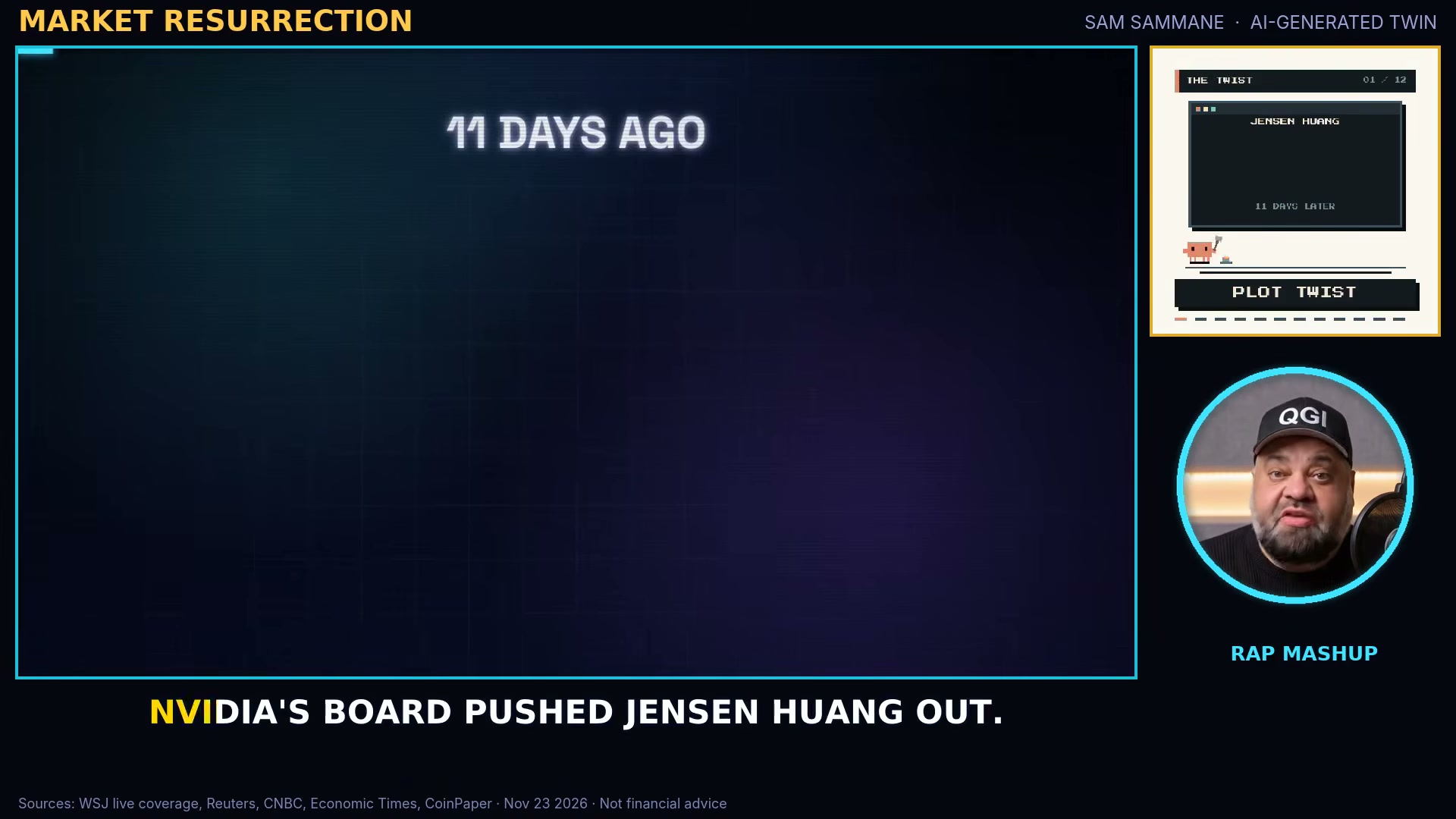 The “11 days ago” title card, at 0:05.
The board’s own words carry the second half of the story. Nvidia’s board said it “received input from senior levels of the United States government”, a line both CNBC and a WSJ article teaser on the live page carry. The board also said the reinstatement “poses no national security risk”, per CNBC.
President Donald Trump then claimed a role. Speaking to CNBC’s Eamon Javers, he said: “I made the deal” (CNBC, 10:08 a.m. ET). He also said “I convinced them”, that he had spoken with the board “directly and indirectly”, and that Huang “did nothing wrong”. According to the same article, the board “did ask for assurance on the national security threat”. The WSJ’s live page confirms the outline: “President Trump spoke with Nvidia’s board” about bringing Huang back, he told CNBC.
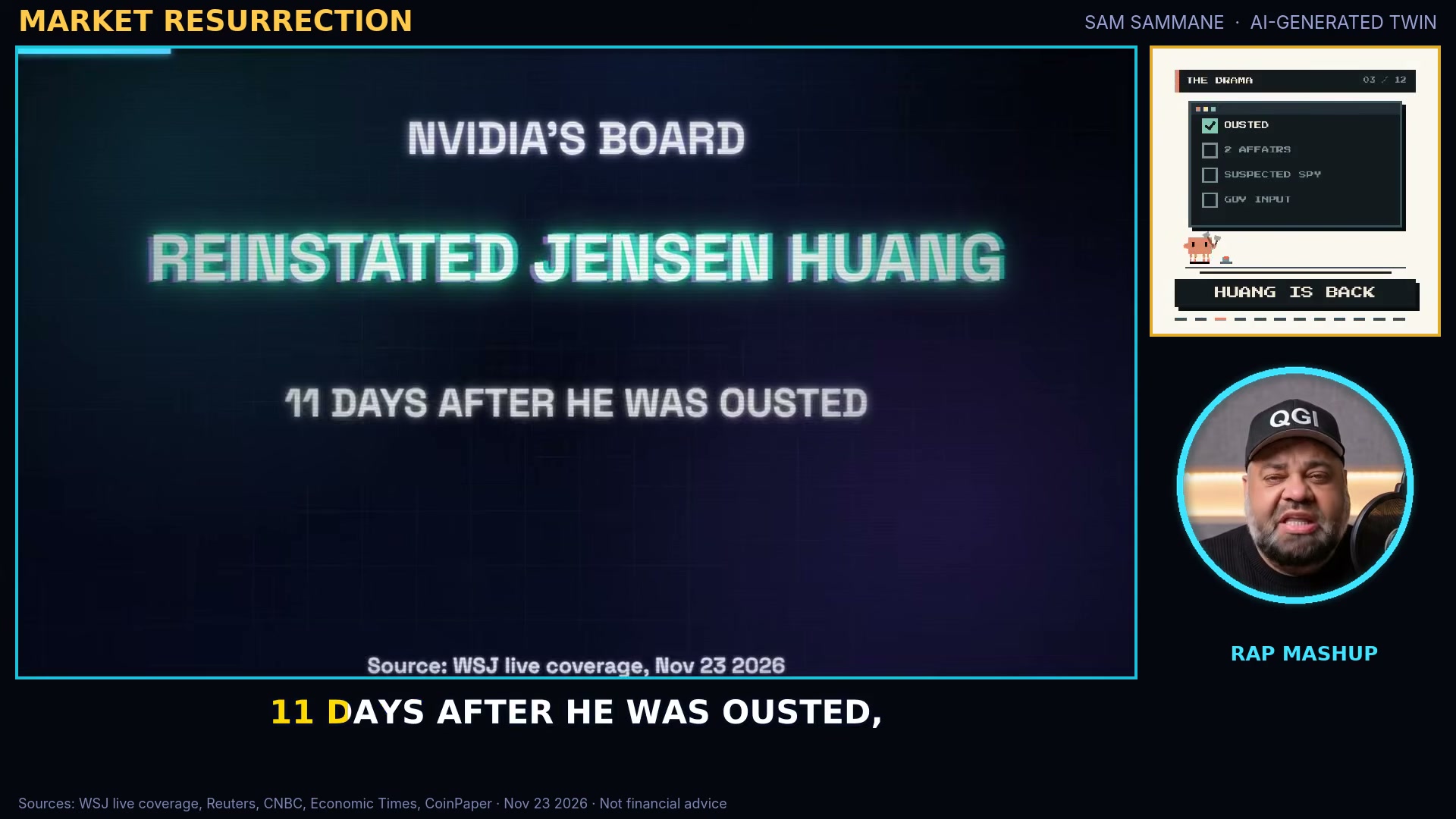 “Nvidia’s board reinstated Jensen Huang 11 days after he was ousted”, at 0:22. The 11 days match the WSJ.
The video’s opening line sets the tone for all of this: “Wall Street just pulled the wildest plot twist of the year” (0:00). The facts behind the joke are plain enough: a resignation, a government consulted, a board statement on national security, and a president saying he brokered the return.
How much did Nvidia stock rise on November 23, 2026?
As much as 36% at the high, per the WSJ. The exact figure depends on the hour, and every outlet published a different one because each wrote at a different time:
- Premarket (WSJ card): “Nvidia shares are up as much as 30% in premarket trading”, at “around $164 a share” (WSJ).
- CNBC tech-rally story (first posted 4:17 a.m. ET, updated later): Nvidia up 30% (CNBC).
- CNBC main story (8:59 a.m. ET, updated later): shares “surged 33%” (CNBC).
- The Economic Times (10:25 a.m. ET, Reuters text): “Nvidia shares surged more than 31%” (ET).
- WSJ main page (stamped 11:51 a.m. ET): shares “soared as much as 36%”, “on pace to add a trillion dollars” to market value (WSJ).
How big is that in history? The WSJ’s own card says that if the gains held, it would be Nvidia’s “biggest one-day percentage move in over two decades”, and its headline reads “Biggest Jump in 23 Years”. The video says “the most in a decade per the journal” (0:36). That phrase is not WSJ text. It came from a MarketWatch item linked on the WSJ page, saying Nvidia’s stock “rose on Monday by the most in a decade”. The WSJ’s wording is the stronger claim, and it is the one to cite.
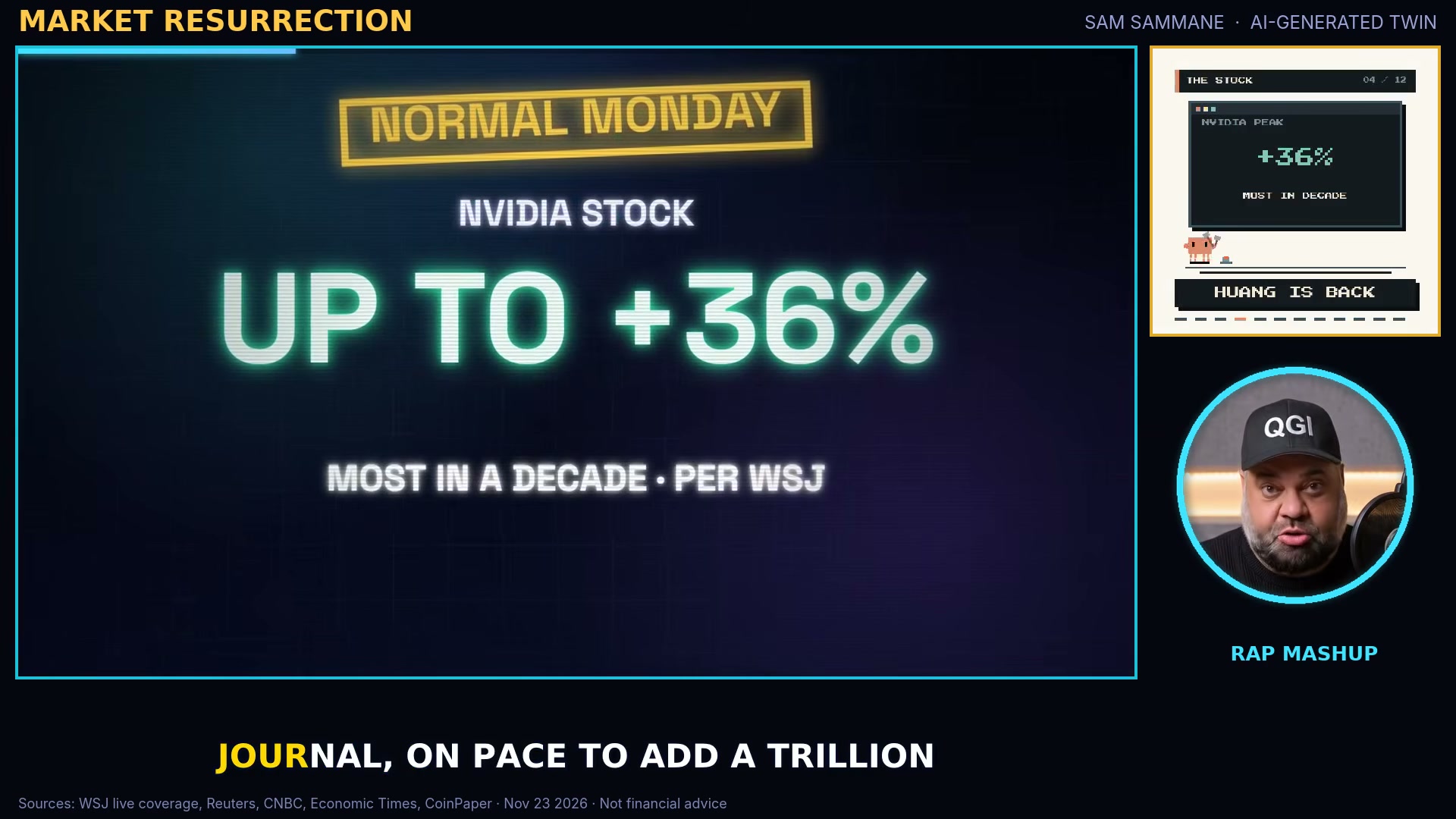 “Nvidia stock up to +36%, most in a decade - per WSJ”, at 0:40. The 36% is the WSJ’s figure; the WSJ’s own words are “biggest one-day percentage move in over two decades”.
Two more numbers give the move its scale. The WSJ card puts Nvidia’s all-time closing high at “$239.24” on October 6, 2026, against a premarket price “around $164” on November 23. CNBC reports the stock had “shed nearly 33%” from November 8 before Monday’s rebound. In other words, even a 30%-plus day left Nvidia well below its October high.
The video’s punchline on the trillion is: “A trillion for rehiring the guy you just fired” (0:44). The trillion is the WSJ’s figure, and it was a pace, not a close. CNBC’s main story gives no market-value figure at all.
What did the indexes do, and at what time?
The Nasdaq Composite was up about 7% in the WSJ’s headline and between 6.45% and 6.99% in its tickers. Those tickers were live and changed through the day. Two WSJ pages captured them about an hour apart:
| Item | 10:50 a.m. ET | About 11:51 a.m. ET |
|---|---|---|
| Dow Jones Industrial Average | 49,669.99 (+3.16%) | 49,629.38 (+3.08%) |
| S&P 500 | 7,262.54 (+5.10%) | 7,237.07 (+4.73%) |
| Nasdaq Composite | 24,198.36 (+6.99%) | 24,076.55 (+6.45%) |
| VIX | 26.42 (-26.39%) | 28.11 (-21.68%) |
| Gold | 3,676.40 (+4.58%) | 3,660.10 (+4.12%) |
| Bitcoin | 62,960.14 (+3.50%) | 62,093.66 (+2.08%) |
| Crude oil | 80.47 (-3.52%) | 80.20 (-3.85%) |
Sources: the WSJ Anthropic card (10:50 a.m. ET) and the WSJ main live page (stamped 11:51 a.m. ET). The video was published at 11:30 a.m. ET, between the two.
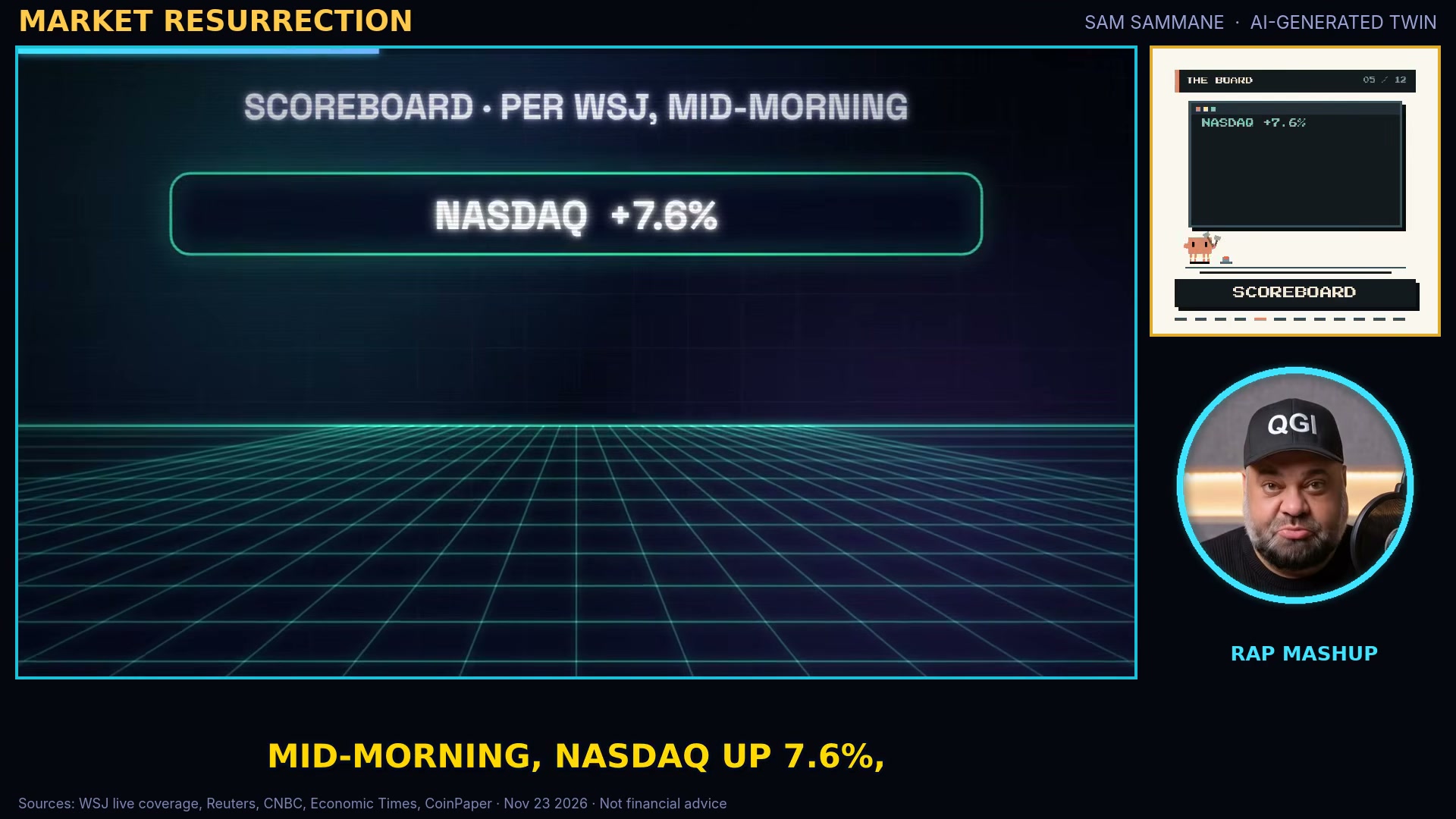 The video’s scoreboard, “Nasdaq +7.6%”, at 0:52. The WSJ tickers I found read +6.99% at 10:50 a.m. ET and +6.45% at about 11:51 a.m. ET.
The WSJ’s text says the same thing in words. Its subhead reads “Nasdaq rebounds 7% after Friday’s bloodbath”; its body says “the Nasdaq surging more than 6%”, and describes the S&P 500 as “escaping correction territory”, without a percentage.
The Nasdaq-100, a narrower index of the 100 largest non-financial Nasdaq stocks, had its own figures. The Economic Times, carrying Reuters text at 10:25 a.m. ET, reported it “climbed 6.6% to 26,680.6 points”, on course for its “biggest single-day percentage gain since April 2025”, and poised to add “more than $2 trillion in market value” (ET). AMD gained more than 8.5%, per both ET and CNBC.
Why such a big bounce? The context is the week before. CNBC reports the Nasdaq “slid 10% last week”, the “Nasdaq’s worst week since 2020”, and “opened more than 6% higher Monday”. Monday’s rebound came straight after that fall.
The rest of the video’s scoreboard, against the WSJ tickers:
- VIX (the CBOE Volatility Index, a gauge of expected stock-market swings often called the fear index): the video says down 24%; the WSJ showed -26.39% at 10:50 a.m. and -21.68% at 11:51 a.m. ET.
- Gold: the video says up; the WSJ showed +4.58% and +4.12%.
- Bitcoin: the video says back above $63,000; the WSJ showed $62,960.14 and $62,093.66. CoinPaper put Bitcoin “around $61,500 on November 23”, up “more than 11%” from Saturday’s low “near $55,250”. Its headline names $64,000 as a target, not a price reached.
- Oil: the video says down 3% at about $80; the WSJ showed $80.47 (-3.52%) and $80.20 (-3.85%).
The video’s line on all this is: “Everybody’s winning except the people who panic sold on Friday” (1:08).
Did Anthropic stock fall on November 23, 2026?
The sources disagree, so here are both readings. CoinPaper, at 2:39 p.m. (time zone not stated), reported that ANT shares fell roughly 3%. Three other outlets reported it flat:
- The WSJ, at 10:49 a.m. ET: “Anthropic shares were trading near flat Monday morning”, while peers “shot up with double-digit percentage gains”. Its main page called Anthropic “One notable outlier”.
- CNBC: “flat after a brief premarket surge”, on the stock’s third trading day.
- The Economic Times, at 10:25 a.m. ET: “largely unchanged after an early premarket spike”.
The morning reports say flat; the one afternoon report says down about 3%. Both can be true at their own hour. What every source agrees on is that Anthropic did not join the rally.
 “Claude is king?”, at 1:15, where the video turns to Anthropic, the company behind Claude.
Anthropic’s ticker is ANT on the Nasdaq (Reuters code ANT.O). The auto-captions render it “NT”; it is ANT. Its first three sessions, in order:
- Thursday, November 19, 2026 (IPO day): priced at $83, opened at $111.50, closed at $97.17, up 17%, per Reuters.
- Friday, November 20, 2026: “ANT closed Friday at $88.91, down 8.5% for the session”, per CoinPaper. CNBC also gives the 8.5% fall.
- Monday, November 23, 2026: flat in the morning (WSJ, CNBC, ET); down roughly 3% in CoinPaper’s afternoon report.
Reuters reports the IPO raised $81 billion, which could rise to as much as $93.5 billion if the underwriters’ option is fully used. With the private placement, the total “sits at over $107 billion”.
Who bought the $26 billion of Anthropic stock?
Two sources describe the same private placement differently, and I give both. A private placement is a sale of shares directly to chosen investors rather than on the open market.
- CoinPaper names Nvidia, AMD, Broadcom and Micron “and several other tech firms” as buyers of about $26 billion of shares, in a concurrent private placement at the $83 IPO price.
- Reuters lists seven placement investors: AMD, Broadcom, Google, Micron, Microsoft, Nvidia and TSMC. Reuters does not state the placement price.
The video names the four chipmakers (1:28), which is CoinPaper’s list without the “several other tech firms”. Reuters’ list adds Google, Microsoft and TSMC.
 “Chip kings / AI king”, at 1:36.
The video’s line here is: “So, the chip kings own a piece of the AI king” (1:34). On November 23, the chip side of that relationship rallied (Nvidia up as much as 36%, AMD up more than 8.5%) while the AI company they bought into stayed flat or slipped, depending on the hour and the outlet.
What are the terms of the CrowdStrike-Zscaler deal?
CrowdStrike agreed to buy Zscaler in “a $43.9 billion all-stock deal”, reported by Reuters at 5:36 a.m. ET (10:36 UTC) and updated at 8:31 a.m. ET (13:31 UTC). Reuters’ headline rounds it to $44 billion. An all-stock deal is one where the buyer pays with its own shares instead of cash.
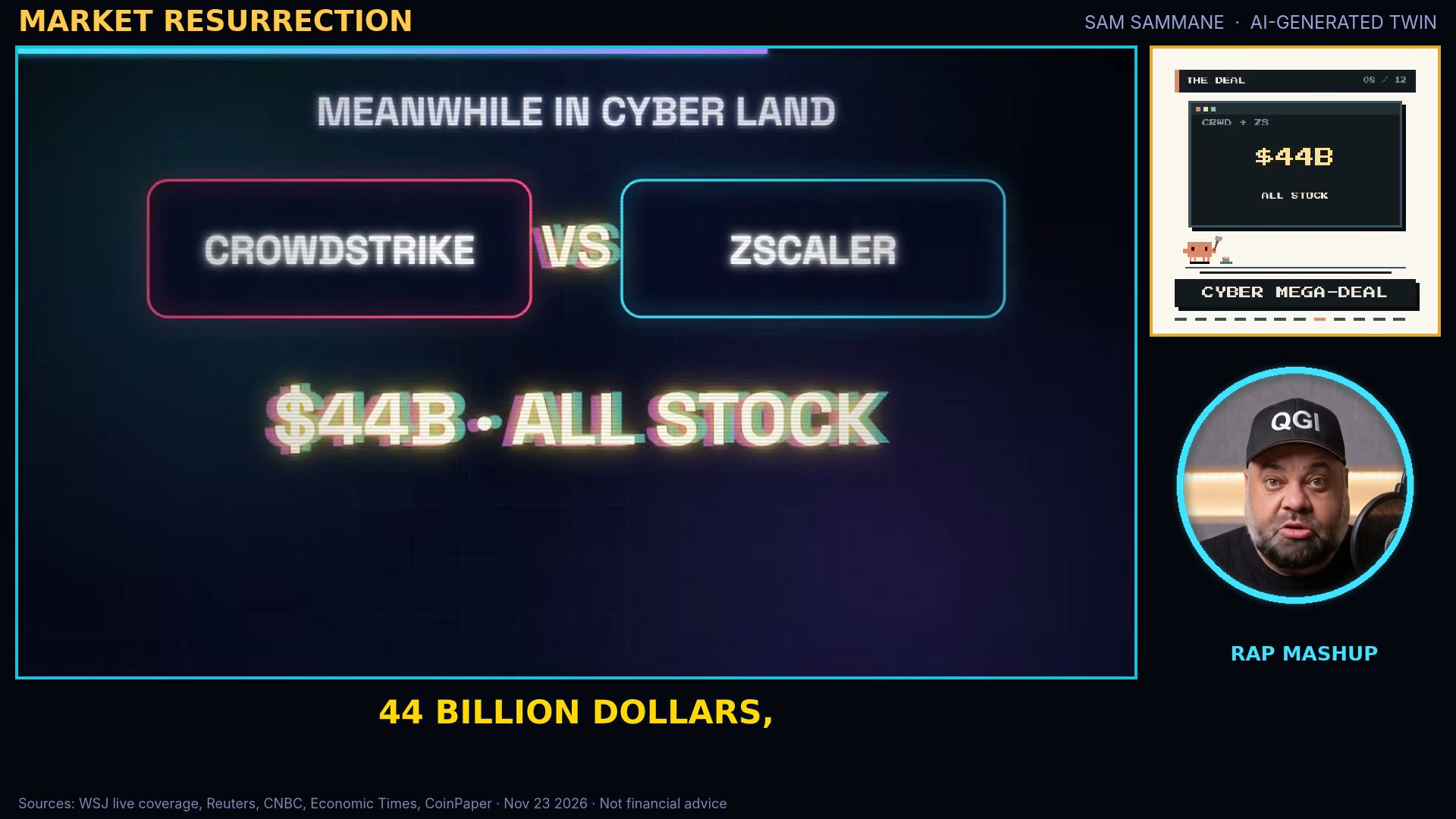 “CrowdStrike vs Zscaler, $44B all stock”, at 1:48. Reuters’ exact figure is $43.9 billion.
The terms, all from Reuters:
- Zscaler shareholders get 1.135 CrowdStrike shares for each Zscaler share, about a 34% premium, for an implied $260.41 per share.
- CrowdStrike shareholders will own about 84% of the combined company.
- There is a $1.4 billion breakup fee.
- George Kurtz will lead the combined company; Jay Chaudhry stays to run the Zscaler business.
- Reuters calls it “the biggest cybersecurity acquisition on record”, against a backdrop where “advances in artificial intelligence fuel increasingly sophisticated cyber threats”.
- Axel Rudolph of IG Group said antitrust scrutiny is “certainly possible”.
- The expected closing date is inconsistent inside the article: the summary says “second half of fiscal 2028”, the body says “second half of 2027”. I note both rather than pick one.
The market reaction is where the video went wrong. It says “both stocks down about 5%”, and jokes: “Nothing says confidence like a group hug and a sell-off” (1:59). Reuters reports the opposite for one of them: “Zscaler shares jumped more than 20% in premarket trading to $235.50”, and “CrowdStrike shares fell nearly 7%”. That fits the terms: Zscaler holders were offered about a 34% premium in CrowdStrike shares. The joke does not survive the source.
What did Talley Leger say about buying Anthropic on day one?
Talley Leger, chief market strategist at The Wealth Consulting Group, said Anthropic “isn’t a prudent ‘buy-at-any-price’ opportunity for retail wealth clients”. Reuters quoted him on November 19, 2026, the IPO day, not on November 23.
He also made the historical point the video paraphrases. In Reuters’ report, Leger said that “retail investors buying hot tech IPOs on day one” historically “underperform broad market indexes over a 3-year horizon”. The three years matter: his claim is about a long holding period and about retail and wealth clients, not about one Monday.
The video compresses all of that into “one strategist said it’s not a buy at any price” and its own translation: “Don’t yolo your rent money” (2:07). The name, the firm, the date and the exact words above are what to cite.
What happened when on November 23, 2026?
A timeline of the reports this record uses, in Eastern Time:
| Time (ET) | Report |
|---|---|
| 4:17 a.m. | CNBC tech-rally story first posted (updated later): Nvidia up 30%, Anthropic flat after a premarket surge |
| 5:36 a.m. | Reuters publishes the CrowdStrike-Zscaler deal (updated 8:31 a.m.) |
| Premarket | WSJ card: Nvidia up as much as 30%, around $164 |
| 8:59 a.m. | CNBC main story: Huang reinstated, shares up 33% (updated later) |
| 10:08 a.m. | CNBC: Trump says “I made the deal” |
| 10:25 a.m. | The Economic Times (Reuters text): Nasdaq-100 up 6.6%, Nvidia up more than 31% |
| 10:49-10:50 a.m. | WSJ Anthropic card and tickers: Nasdaq +6.99%, Anthropic near flat |
| 11:30 a.m. | The TheoSym video is published |
| About 11:51 a.m. | WSJ main page: Nvidia as much as 36%, Nasdaq +6.45% |
| 2:16 p.m. and 2:39 p.m. | CoinPaper on Bitcoin and on Anthropic (time zone not stated) |
I did not capture closing prices from the named sources, so this record stops at the intraday reports.
How I checked these numbers
I hold a PhD in formal verification, and my company builds AI that shows its work. A market recap deserves the same treatment as any other claim: name the source, give the time, and say where the claim and the source disagree.
For this page, the check read 11 pages from the five outlets the video’s description names, and nothing else. Three limits apply:
- Paywalls. The WSJ live-coverage cards sit behind a registration or paywall. Only the visible parts were used: headlines, summaries, lead text and the market-data ticker strips.
- Live tickers. The WSJ tickers changed by the minute. The two snapshots above are what was captured; other values existed at other moments.
- Named outlets only. Some outlets the video does not name had figures closer to the video’s. I left them out, because the video said its numbers came from the five it named, and those five are the test.
 “Recap: CEO fired, CEO rehired”, at 2:20.
The video ends with a question for viewers: “Is this a healthy market or a reality show with tickers?” (2:25). Whatever your answer, it should rest on the right numbers, and that is the job of this page.
Key takeaways
- Jensen Huang returned as Nvidia CEO on November 23, 2026, 11 days after he was ousted, with the board citing input from senior levels of the US government and saying the move “poses no national security risk”.
- Nvidia rose as much as 36% that day, per the WSJ, which said it was on course for the biggest one-day percentage move in over two decades. “Most in a decade” was MarketWatch’s phrase.
- WSJ tickers had the Nasdaq up 6.99% at 10:50 a.m. ET and 6.45% at about 11:51 a.m. ET; the video’s 7.6%, 5.5%, 3.4% and -24% do not appear in the named sources.
- Anthropic (ANT) was flat in the morning per the WSJ, CNBC and ET, and down roughly 3% in CoinPaper’s afternoon report.
- CrowdStrike’s $43.9 billion all-stock purchase of Zscaler sent Zscaler up more than 20% premarket and CrowdStrike down nearly 7%, per Reuters.
FAQ
Why was Jensen Huang reinstated as Nvidia CEO?
Nvidia’s board brought him back on November 23, 2026, saying it “received input from senior levels of the United States government” and that the reinstatement “poses no national security risk”, per CNBC. President Trump told CNBC “I made the deal” (CNBC).
Was Nvidia’s jump the biggest in a decade?
Bigger, by the WSJ’s account. The WSJ said it was on course to be Nvidia’s “biggest one-day percentage move in over two decades” and headlined it “Biggest Jump in 23 Years” (WSJ). “Most in a decade” came from a MarketWatch item linked on the WSJ page.
How much was the Nasdaq up on November 23, 2026?
About 7% by the WSJ’s headline. Its tickers read +6.99% at 10:50 a.m. ET and +6.45% at about 11:51 a.m. ET. The Nasdaq-100 was up 6.6% at 10:25 a.m. ET, per The Economic Times.
Did Anthropic stock go down while AI stocks rallied?
It depends on the hour and the outlet. CoinPaper reported ANT down roughly 3%; the WSJ (10:49 a.m. ET), CNBC and The Economic Times reported it flat or largely unchanged. All agree it missed the rally.
Did CrowdStrike and Zscaler stock both fall on the deal?
No. Reuters reports Zscaler jumped more than 20% in premarket trading to $235.50 and CrowdStrike fell nearly 7% (Reuters).
Who said Anthropic is not a buy at any price?
Talley Leger, chief market strategist at The Wealth Consulting Group, in Reuters on November 19, 2026: Anthropic “isn’t a prudent ‘buy-at-any-price’ opportunity for retail wealth clients” (Reuters).
Watch, then cite the sources
Nothing on this page is financial advice. It is a record of what was reported, by whom, and when.
The video gives you the day in under three minutes; this page gives you the sources to cite:
If you want the next TheoSym recap when it comes out, join here.
About the author
I am Dr. Sam Sammane, Founder and Chief Executive Officer of Quantum General Intelligence Inc. (QGI), which builds AI that shows its work, and I hold a PhD in formal verification.